What Are Penny Stocks? The Foundation Every Beginner Needs
Learning how to invest in penny stocks for beginners starts with understanding why this corner of the US stock market attracts so many new traders in the first place. Penny stocks shares typically priced under $5, with many of the most actively traded names well under $1 allow beginners to participate in real market activity, learn how price and volume interact, and develop practical trading experience without needing significant starting capital. For anyone looking to understand how financial markets work from the ground up, penny stocks offer a hands-on learning environment that more expensive asset classes simply cannot match.
What makes penny stocks particularly interesting in 2026 is the quality of information infrastructure now available to retail traders. Pre-market watchlists, real-time buy and sell signals, chart analysis tools, and private trading communities have made it possible for a beginner to enter this market with genuine preparation rather than guesswork. The gap between what professional traders and retail beginners have access to has narrowed considerably, and for those willing to learn the process correctly, the opportunities are meaningful.
Learning how to invest in penny stocks for beginners goes well beyond picking a stock and hoping it moves. It involves understanding how signals work, when to enter and exit a position, how to read volume patterns, and how to size a trade appropriately. Platforms like Whiskey’s Penny Picks are built specifically around this educational need providing members with pre-market buy and sell signals, daily market guidance, and direct coaching access so that new traders are not navigating this market without structure. For anyone serious about developing real trading skills, having access to a Guide for New Traders that combines live signals with ongoing education changes the learning curve significantly.
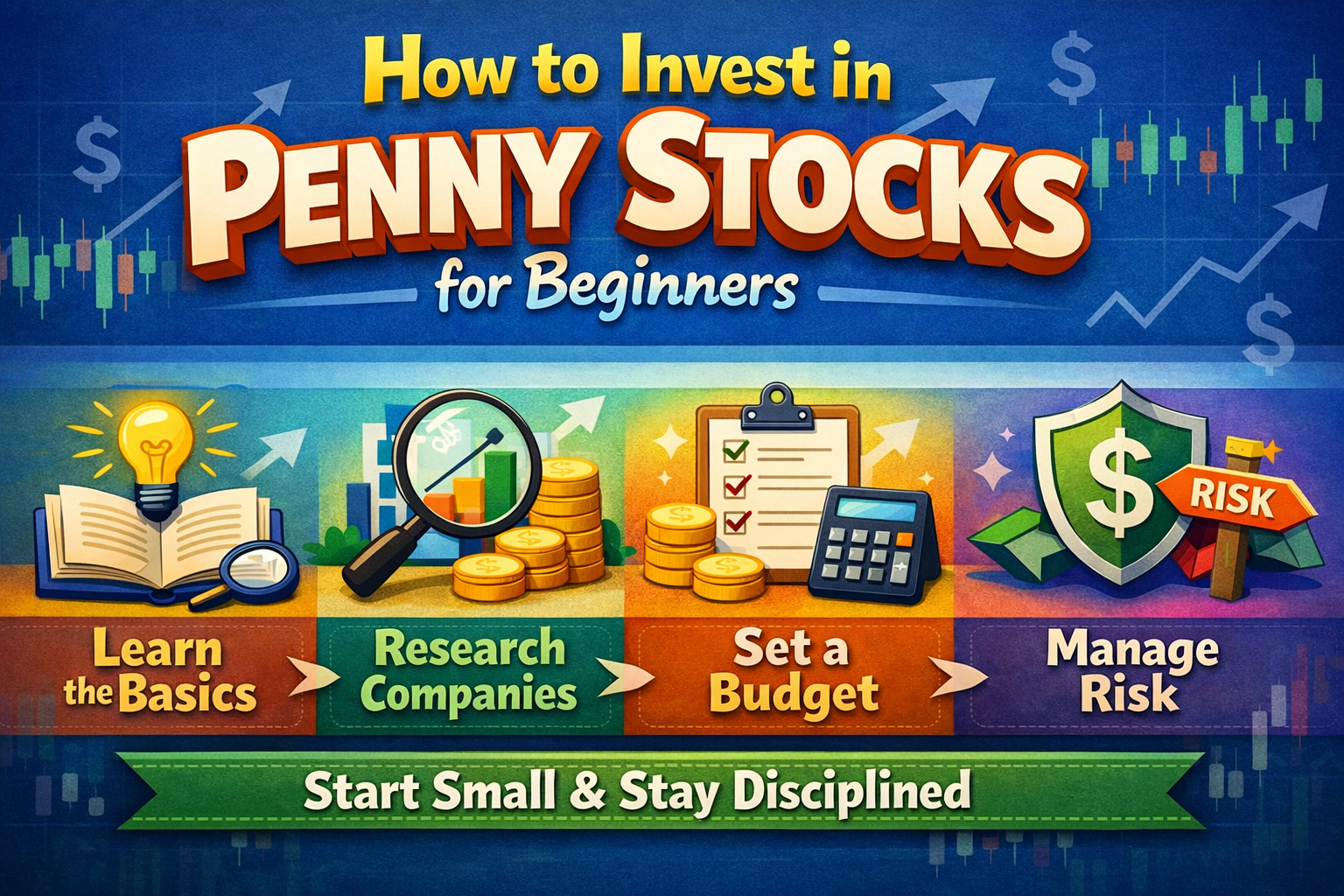
This guide covers the foundational knowledge every beginner needs: what penny stocks are, how signals help traders identify opportunities, how to read basic chart patterns, what strategies experienced traders use, and how to build consistent trading habits from the start.
What Are Penny Stocks and How Do They Work?
Penny stocks are shares of small companies that trade at low prices, generally defined by the SEC as stocks priced below $5 per share. In practice, the most actively traded names in this space are often priced below $1 and in the sub-penny category, below $0.01. These stocks trade primarily on OTC (over-the-counter) markets rather than major exchanges like the NYSE or Nasdaq, which means they operate under different reporting requirements and attract a different type of market participant than large-cap stocks.
The core mechanic that defines penny stocks is simple: low prices amplify percentage moves. A stock at $0.25 that reaches $0.50 has doubled. That same dollar move on a $50 stock? Just a 2% change. This is why penny stocks attract active traders small price shifts create large percentage gains.. This amplified sensitivity to volume and order flow is what creates the trading opportunities that attract active retail traders to this space.
Penny stocks typically move in response to specific catalysts: earnings announcements, contract wins, regulatory approvals, sector momentum, or unusual pre-market volume. Understanding what types of catalysts historically drive meaningful moves and being positioned in a stock before that catalyst becomes widely known is the foundation of effective penny stock trading.
OTC Markets and How Penny Stocks Are Traded
OTC stocks trade through a dealer network, not a centralized exchange. OTC Markets Group quotes these stocks and organizes them into three tiers. OTCQX (highest standards), OTCQB (venture market), and Pink Sheets (no minimum standards). Most highly speculative penny stocks trade on the Pink Sheets tier. Understanding which tier a stock belongs to helps traders assess the level of company transparency and reporting available before taking a position.
Trading mechanics on OTC stocks differ from exchange-listed stocks in one important practical way: bid/ask spreads are often wider, and liquidity can vary significantly throughout the trading day. This is why experienced penny stock traders use limit orders rather than market orders to control the exact price at which they enter or exit a position rather than accepting whatever the market offers at execution time.
Sub-Penny Stocks: What Beginners Should Know
Sub-penny stocks those priced below $0.01 per share represent the most speculative segment of the penny stock market.
Sub-penny trading requires large share counts to generate meaningful dollar returns. Many companies in this tier publish limited financial disclosures.
. However, when a strong catalyst meets a low-float sub-penny stock with building volume, the percentage moves can be dramatic and fast. Traders interested in this space need to understand position sizing carefully, as the dollar volatility per trade can accumulate quickly even at fractional share prices.
Why Penny Stocks Are a Practical Starting Point for New Traders
For someone entering the stock market for the first time, penny stocks offer a set of practical advantages that more expensive instruments do not. The most immediate is the low capital requirement. A trader can open an account with a few hundred dollars, build a watchlist, follow pre-market alerts, and participate in real trades gaining hands-on market experience that no amount of paper trading or course study can fully replicate.
The second advantage is speed of feedback. Penny stocks move fast. A position that is entered at market open can be fully resolved either at a profit or at a pre-determined exit within the same trading session. This rapid cycle of entry, management, and exit compresses the learning timeline significantly. A beginner who actively trades penny stocks for three months develops real market intuition fast. Reviewing sessions and studying patterns compresses years of learning into weeks. Passive index investing simply cannot offer that pace of feedback.
The third advantage, specific to 2026, is the quality of support infrastructure available to retail traders. Signal services, private Discord communities, daily market updates, and coaching access from experienced traders have made the penny stock learning curve far more manageable than it was even five years ago. Beginners are no longer starting from zero they are starting with curated watchlists, explained signal rationale, and a community of peers going through the same learning process simultaneously.
What Beginners Need to Understand Before Their First Trade
- Penny stocks are short-term trading instruments, not long-term investment vehicles. The strategies used in this space are fundamentally different from buy-and-hold investing.
- Volume is the primary indicator. A price move on high volume means something different than the same move on thin volume. Learning to read volume patterns is the single most important early skill.
- Pre-market preparation determines outcomes. The traders who make consistent decisions are the ones who have a plan before the market opens not the ones reacting in real time without context.
- Position sizing is not optional. Understanding how much capital to commit to any single trade is a foundational skill that protects the account while the trader is still developing experience.
- A structured learning environment accelerates development. Access to experienced traders, verified signal history, and real-time coaching compresses the time it takes to move from beginner to consistently profitable.
Expert Penny Stock Trading Signals: What They Are and How They Help Beginners
A trading signal is a specific, actionable alert that identifies a stock worth watching with an entry price range, the catalyst or technical setup driving the opportunity, and the context a trader needs to make an informed decision. Expert penny stock trading signals go beyond simply naming a ticker. They explain why a stock is positioned for a potential move, what volume activity or news event is behind it, and what a reasonable trade looks like given current market conditions.
For beginners, the value of professional signals is twofold. First, they remove the need to independently scan hundreds of charts every morning looking for setups a task that requires significant technical knowledge and hours of pre-market time. Second, and more importantly for skill development, a well-explained signal teaches the trader something. When you receive a signal for a specific stock at a specific price and then watch that stock move exactly as the alert described something clicks. You start recognizing patterns. That recognition is what experienced traders spend years building. Signals accelerate that process dramatically.
Whiskey’s Penny Picks delivers pre-market signals each trading morning with clear entry ranges and the reasoning behind each pick. Members also receive a daily hot list a curated set of stocks showing elevated volume or strong catalyst potential alongside direct access to coaching and guidance through a private Discord community. This structure means beginners are not just receiving alerts to act on blindly; they are receiving alerts with enough educational context to understand what the setup looks like and why it is being flagged.
What a Quality Signal Includes
- Specific ticker and suggested entry price range not a vague ‘watch this stock’ note.
- Catalyst or technical setup explanation volume breakout, news event, sector momentum, or pattern formation.
- Pre-market timing delivered before the regular session opens so traders can prepare their plan.
- Float and volume context so the trader understands the mechanics behind why this stock can move significantly.
- Follow-up during the session updates through the trading community as conditions evolve throughout the day.
Understanding Pre-Market Signals and Why Timing Matters
The most significant penny stock moves frequently occur in the first 30 to 90 minutes of the regular trading session. Stocks that have been flagged in pre-market, that are already showing unusual volume before 9:30 AM Eastern, and that have a clear catalyst are often in their most liquid and directional phase right at market open. A trader who has reviewed the signal, identified their entry range, and is ready to execute at open is positioned to participate in that initial move rather than seeing it on a chart after the fact and trying to assess whether it is too late to enter.
This is why pre-market delivery is a defining feature of quality signal services. Signals received after a stock has already made its primary move have significantly less utility for the trader. The preparation window the time between receiving a signal and market open is when informed trading decisions are made, not during the volatility of live market action.
Penny Stock Profits with Buy and Sell Signals: How Active Traders Use Alerts
Understanding how penny stock profits with buy and sell signals actually work in practice requires separating two distinct phases of a trade: the entry decision and the exit decision. Most beginners focus almost entirely on finding the right stock to buy. Experienced traders understand that when you sell is just as important as when you buy and that a disciplined exit strategy is what converts a potentially profitable setup into an actually realized gain.
A buy signal identifies a stock at or near an optimal entry point typically before a catalyst has been fully priced in by the broader market, or as a volume breakout is beginning to develop. The signal gives the trader a price range to watch, the context behind the setup, and the information needed to size the position appropriately. Acting on a buy signal is not an instruction to buy at any price it is an invitation to prepare a plan and execute that plan if the stock meets the criteria at the time of entry.
A sell signal or exit guidance comes when the original thesis has played out, when momentum is showing signs of exhaustion, or when a more attractive opportunity changes how capital should be allocated. Following both entry and exit guidance captures more of the intended move. Buying on a signal then holding without a plan is where gains disappear. Exit discipline is what turns paper profits into real ones.
Real-World Examples of Signal-Based Trades
The following picks are drawn from Whiskey’s Penny Picks’ publicly verified track record on Stocktwits, where every pick is documented with timestamps so members can independently verify performance:
- BKKT: Picked at approximately $12.50. Hit an intraday high of $49.79 a gain of nearly 400%.
- IPDN: Picked at $2.40. Reached $12.39 over the following weeks a gain of over 400%.
- AIRE: Picked at $0.22. Hit an intraday high of $0.98 a gain of approximately 345%.
- BYND: Picked at $1.02. Hit an intraday high of $3.86 the following day a gain of over 275%.
- SKYQ: Picked at $0.5303 at 6:09 AM PDT. Hit $1.12 by 7:45 AM PDT the same morning over 100% in under two hours.
These examples illustrate what structured, signal-based penny stock trading can look like in practice. The picks are timestamped pre-market, the entries are specific, and the outcomes are publicly verifiable. This level of transparency is what allows members to build genuine confidence in the signals they are following rather than acting on blind faith.
Penny Stock Profit Strategies: Approaches That Work for Active Traders
There is no single penny stock profit strategy that produces results in every market condition. What successful traders share is not a single method but a disciplined framework a set of criteria they apply consistently that gives them a statistical edge over time. Below are the three core strategic approaches most commonly used by experienced penny stock traders, along with how each one works in practice.
Strategy One: The Pre-Market Catalyst Play
This is the most straightforward strategy and the one most closely aligned with following professional signals. The setup requires a stock with a clear, time-sensitive catalyst earnings results, a contract announcement, a clinical trial result, or regulatory approval that the broader market has not yet fully responded to. The signal identifies this stock pre-market, provides an entry range, and gives the trader time to build a position before the regular session begins.
The discipline required in this strategy is execution precision. Entering at or near the suggested range rather than chasing the stock if it opens significantly higher is what determines whether the trade has a favorable reward-to-risk profile. Stocks that gap up significantly at open past the signal’s suggested entry often represent trades that were missed rather than opportunities that need to be pursued at any price.
Strategy Two: The Volume Breakout Setup
Volume breakout plays target stocks that are trading at significantly higher volume than their historical average often three to ten times normal without a clear public news catalyst. This unusual volume pattern suggests that informed participants are accumulating a position ahead of an anticipated event. When a low-float stock begins showing this type of pre-market volume accumulation, experienced traders recognize it as a potential setup for an accelerated price move once the regular session begins.
Reading volume correctly is a skill that develops with practice and exposure to real markets. Seeing how different volume profiles interact with price action comparing breakouts that follow through versus those that reverse is one of the most valuable pattern recognition exercises a beginner can engage in. Quality signal services that explain the volume context behind each pick accelerate this learning significantly.
Strategy Three: The Swing Trade Position
Not every penny stock trade is designed to be completed within a single session. Swing trading involves identifying stocks that are forming multi-day technical patterns consolidations near resistance, higher-low formations, or recovery moves after a correction and holding them for days or weeks as the pattern develops. Swing trades require more patience than intraday plays but often offer more predictable reward-to-risk profiles because the entry and exit points can be planned more methodically.
For beginners, swing trades have a useful secondary benefit: they remove the minute-to-minute pressure of intraday trading and allow more time to observe how a stock behaves, how volume patterns develop over multiple sessions, and how broader market conditions affect individual stocks. This observational experience builds the contextual knowledge that makes future intraday trades easier to evaluate.
Reading Penny Stock Charts: Essential Concepts for Beginners
Chart reading is a skill that develops gradually through exposure to real market data, not through memorizing definitions. For beginners, the goal is not to master every technical indicator available it is to develop a solid working understanding of the two or three elements that matter most in penny stock trading. Everything else can be added incrementally as experience grows.
Volume: The Most Informative Single Indicator
Volume measures how many shares of a stock have traded in a given time period. It is displayed as a bar chart along the bottom of most price charts. In penny stock trading, volume is the foundational indicator because it reveals the strength of conviction behind any price move. A stock moving up 30% on ten times its average daily volume is a meaningfully different situation from the same 30% move on normal volume. The first suggests real, sustained buying interest from multiple participants; the second may reflect thin market conditions where a small number of trades are creating the appearance of movement.
Volume analysis in practice means developing a sense of what is normal for a given stock and immediately recognizing when something has changed. Pre-market volume is particularly informative a stock showing heavy buying activity before the regular session opens is often being positioned by traders who have information or a strong thesis ahead of market open. This is why signals that include pre-market volume data provide significantly more context than simple price alerts.
Float: Understanding Why Some Stocks Move More Than Others
A stock’s float is the total number of shares available for public trading the shares that are not held by insiders, institutions with lock-up periods, or the company itself. Low-float stocks have fewer shares in circulation, which means any given level of buying activity has a proportionally larger impact on price. A stock with 2 million shares in its float and 500,000 shares trading in the first hour is experiencing 25% of its available supply changing hands a rate that produces significant price movement. The same 500,000 shares in a stock with 200 million float would barely register on a chart.
Understanding float is essential for contextualizing why certain penny stocks make dramatic moves while others with similar catalysts do not respond as strongly. Low-float stocks with strong catalysts and building volume offer the highest-probability setups. This is why signal services screen for float as a core part of their pick selection process.
Support, Resistance, and Entry Planning
Support levels are price points at which a stock has historically found buying interest levels where the stock has bounced multiple times, suggesting that buyers consider the price attractive at that level. Resistance levels are the inverse: price points where selling pressure has historically capped upward movement. For beginners, these two concepts provide a practical framework for planning entries and exits without needing to master advanced technical patterns.
A common beginner application is to look for stocks trading near established support levels as a potential entry point buying near a level where historical demand has been strong, with a defined exit if the stock moves below that support. Similarly, having a resistance level as a near-term profit target provides a logical point at which to consider reducing or exiting a position rather than holding indefinitely waiting for further gains.
Penny Stock Trading: Building the Daily Habits That Drive Consistent Results
Penny stock trading is less about finding the perfect stock and more about executing a consistent process correctly, day after day. The traders who build durable results in this space are not necessarily the ones with the most technical knowledge they are the ones who have internalized a set of daily habits that keep their decision-making structured and their learning compounding over time.
The most important of these habits is pre-market preparation. Every productive trading session begins the night before or early in the morning reviewing the market calendar for catalysts, checking which stocks on the watchlist are showing pre-market activity, reviewing signal alerts as they arrive, and building a clear plan for each position being considered. Traders who arrive at 9:30 AM without a plan react instead of execute. The market moves fast. Arriving with a written watchlist, defined entry ranges, and pre-set exit criteria is what separates prepared traders from everyone else.
Whiskey’s Penny Picks structures its daily service around this exact pre-market preparation cycle. Members receive morning alerts before the session opens, a curated daily hot list of stocks showing elevated potential, and ongoing commentary throughout the day through the private Discord. For traders who are building their first consistent trading routine, having this daily structure provided externally creates a framework that would otherwise take months to develop independently. If you are ready to build that routine with professional guidance from day one, Start Trading for Beginners and gain access to everything the community provides.
Developing a Pre-Market Routine
- Review pre-market signal alerts and hot list as soon as they arrive typically between 4 AM and 7 AM Eastern.
- For each flagged stock, check pre-market volume, current bid/ask, and whether the entry range is still valid.
- Write down your entry price, profit target, and exit level for each position you plan to trade. Do not rely on memory once the market opens.
- Check the broader market pre-market indicators futures, sector momentum to understand whether the general environment favors the setups you are planning.
- Be at your platform and ready before 9:25 AM. The first five minutes of trading are often the most decisive for penny stock setups.
Post-Session Review: Where the Real Learning Happens
The daily trading session is where decisions are executed. The post-session review is where skills are actually developed. Taking 10 to 15 minutes after each session to review what happened whether your planned setups triggered, how each position developed, whether your entries and exits matched your plan builds the analytical habit that separates improving traders from those who repeat the same mistakes.
Keeping a simple trade journal does not need to be elaborate. Recording the ticker, your planned entry and exit, what actually happened, and one observation about what you would do differently is enough. Over weeks and months, this record becomes an invaluable dataset that reveals patterns in your own decision-making the conditions under which you trade well, the emotional triggers that lead to deviation from plan, and the setups that consistently perform versus those that do not.
The traders who improve fastest are not those who trade the most they are those who review the most deliberately. Two well-reviewed trades per session will develop skill faster than ten trades executed without reflection.
Why Trading Community Accelerates Beginner Development
Trading alone especially in the early stages of learning creates a specific set of challenges that community membership addresses directly. The most significant is the absence of real-time perspective. When a stock on your watchlist is moving unexpectedly or a trade is developing differently than anticipated, having no one to consult means making high-stakes decisions with limited context. Experienced traders in a live community can often provide the context that changes a poor decision into a good one in under a minute.
The second challenge of solo trading is accountability. Without external structure, it is easy to deviate from a trade plan the moment a stock moves against a position, or to take a trade that does not meet the criteria that were previously set. Trading within a community where decisions are visible even informally creates social accountability that reinforces disciplined behavior in ways that personal rules alone do not always achieve.
The third challenge is the pace of learning. Solo traders learn from their own trades only. Community traders learn from every trade discussed in the group the setups that worked, the ones that did not, and the reasoning shared by more experienced members in both cases. Over three months, a community member learns from every trade discussed in the group wins, losses, and reasoning alike. A solo trader only learns from their own trades. The difference in education volume is significant
What to Look for in a Quality Trading Community
- Live communication during market hours not just pre-market alerts, but active discussion as the session unfolds.
- Verified track record picks documented publicly with timestamps so performance can be assessed independently.
- Direct coaching access the ability to ask questions and receive guidance specific to your trades and experience level.
- Educational framing experienced members who explain the reasoning behind setups, not just the ticker symbols.
- Mix of trade types day trade alerts alongside swing setups, so members are exposed to different strategies and timeframes.
Common Mistakes Beginners Make in Penny Stock Trading
Acting on Unverified Tips Rather Than Structured Signals
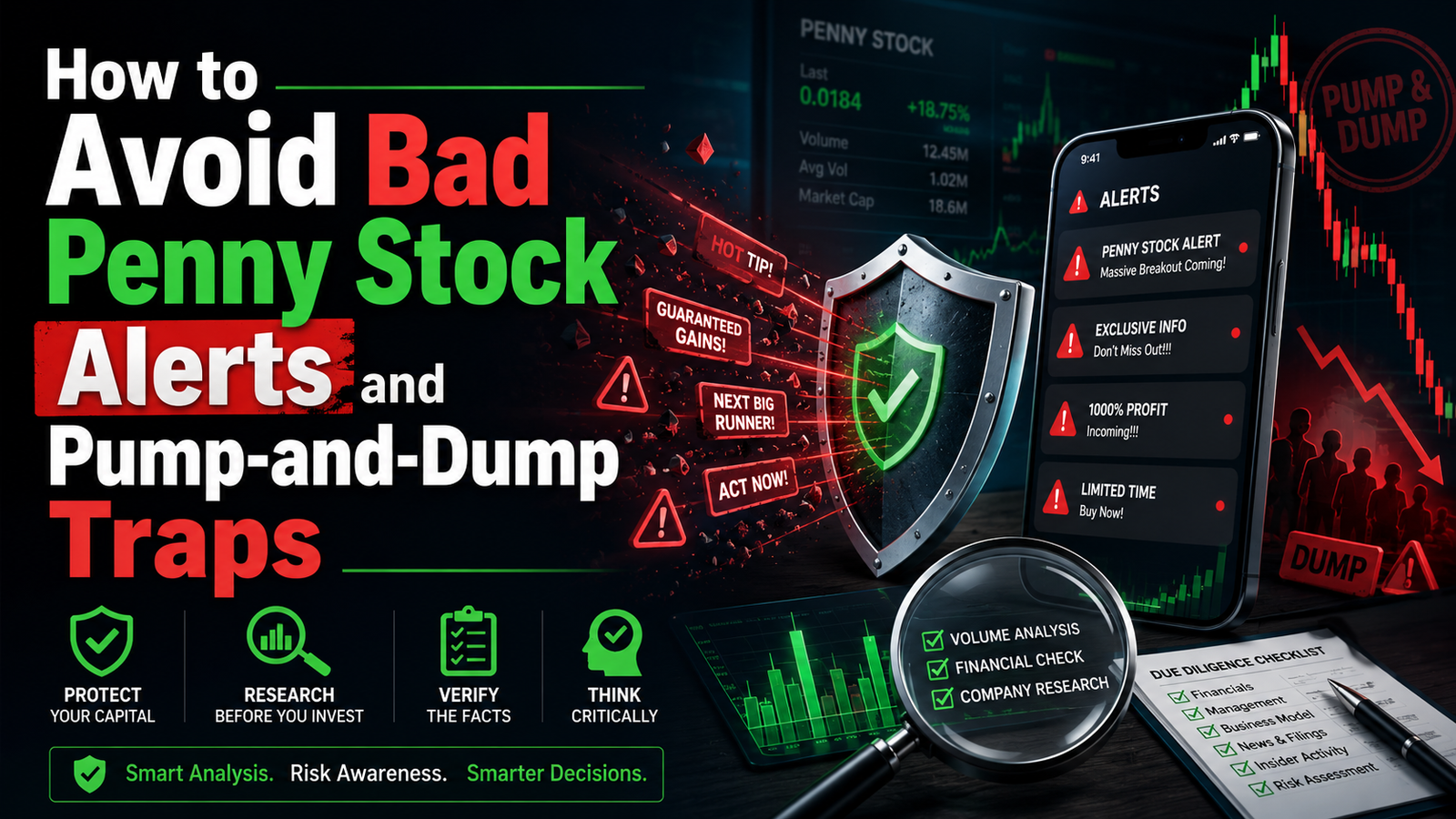
Social media, message boards, and group chats are filled with penny stock tips that arrive with no verifiable track record, no entry context, and no rationale. By the time a stock is circulating publicly as a recommendation, the setup is often already past its optimal entry point. Learning to distinguish between structured, explained signals from a source with a public track record and anonymous tips circulating on social platforms is one of the first critical skills a beginner needs to develop.
Using Market Orders on OTC Stocks
OTC penny stocks often have wide bid/ask spreads, particularly during the first minutes of the trading session when volatility is highest. A market order in this environment accepts whatever price the market offers at execution which can be significantly higher than the last traded price shown on a chart. Using limit orders for all penny stock entries and exits gives the trader control over the price at which they transact, which is essential for maintaining the favorable entry levels identified in pre-market signals.
Ignoring Volume When Evaluating a Setup
Price action without volume context is incomplete information. A penny stock moving 40% on thin volume is a fundamentally different situation from the same 40% move on five times normal volume. The first may be fragile and easily reversed; the second suggests real buying interest with more durability. Before acting on any penny stock setup, always cross-reference the price move with current volume relative to that stock’s historical average.
Entering Trades Without a Written Exit Plan
Every trade entered without a predetermined exit strategy is a trade where the exit decision will be made under emotional pressure in real time. This is the condition under which most poor trading decisions occur. Before entering any penny stock position, the exit criteria both the profit target and the level at which the trade thesis is considered invalid should be identified and written down. This simple habit removes the emotional component from what should be a purely analytical decision.
Expecting Results Before Completing the Learning Phase
Penny stock trading is a skill that develops over time with deliberate practice. Beginners who approach the market expecting immediate consistent profits, rather than treating the early period as a structured learning phase, often make oversized bets early and exit the market entirely after avoidable losses. The correct expectation for the first 60 to 90 days is to develop process fluency the ability to receive a signal, plan a trade, execute it correctly, and review it afterward. Profits follow the mastery of process, not the other way around.
Conclusion: The Right Foundation for Penny Stock Trading
Learning how to invest in penny stocks for beginners in 2026 is not about finding a magic ticker or getting lucky on a single trade. It is about building a structured approach: understanding how these stocks move, knowing how to read volume and chart patterns, following expert buy and sell signals with a prepared trade plan, and developing the daily habits that compound into real trading skill over time.
The foundation consists of three elements working together. First, reliable information pre-market signals that arrive early enough to be actionable, with enough context to be educational. Second, a disciplined process a pre-market routine, written trade plans, consistent position sizing, and post-session review that drives continuous improvement. Third, community support access to experienced traders whose real-time perspective and coaching accelerates the development that would otherwise take years of solo trading to achieve.
Whiskey’s Penny Picks provides all three elements in a single membership: expert penny stock trading signals delivered pre-market every morning, penny stock profit strategies explained through daily hot lists and swing trade picks, ongoing penny stock trading guidance through private Discord coaching, and a transparent, publicly verifiable track record. For beginners who want to build real trading skills from day one with structure, education, and community Start Trading for Beginners and join a community designed specifically to support the learning curve from the very first session.